

I walked through the streets of D.C. carrying a huge sign, rain pouring down in sheets. People stopped and stared. Emily’s photo always stopped people. She was so beautiful that strangers couldn’t quite believe something so terrible had happened to her—as if beauty alone could protect her. There was a small satisfaction in the surprise on their faces. I wanted them to know this epidemic could touch anyone, and today it touches almost everyone in some way.


As I approached the makeshift graveyard of cardboard tombstones, the rain came harder. A tall man stopped me. He introduced himself as Dr. Stephen Loyd and looked at Emily’s photo. Above her picture were the stark words: “My child died from fentanyl.”
“I am so sorry,” he said softly. Then he added, “Emily was beautiful.”
“Yes, she was,” I replied, as I always do. His sincerity struck me, especially as we stood among thousands of tombstones—so many other “Emilys.” I also knew who he was: the Tennessee physician whose story inspired Michael Keaton’s character in Dopesick. Dr. Loyd himself had once become addicted to painkillers at the height of the opioid epidemic. He’d been given a second chance and devoted his life to helping others with substance use disorder find theirs.
Though grateful for the encounter, the tropical depression slamming D.C. in 2023 was relentless. Dr. Loyd was scheduled to speak at Trail of Truth that year, but the weather canceled all the speakers. My travel companion, Michael—capturing social media for the day—and I returned to our hotel, soaked to the bone.
Fast forward to 2025: another memorial display in front of the Capitol. I was asked to be a speaker. Michael, now working full-time for Emily’s Hope, came with me to record a podcast episode with families sharing their stories. This time, I hoped the weather would hold.


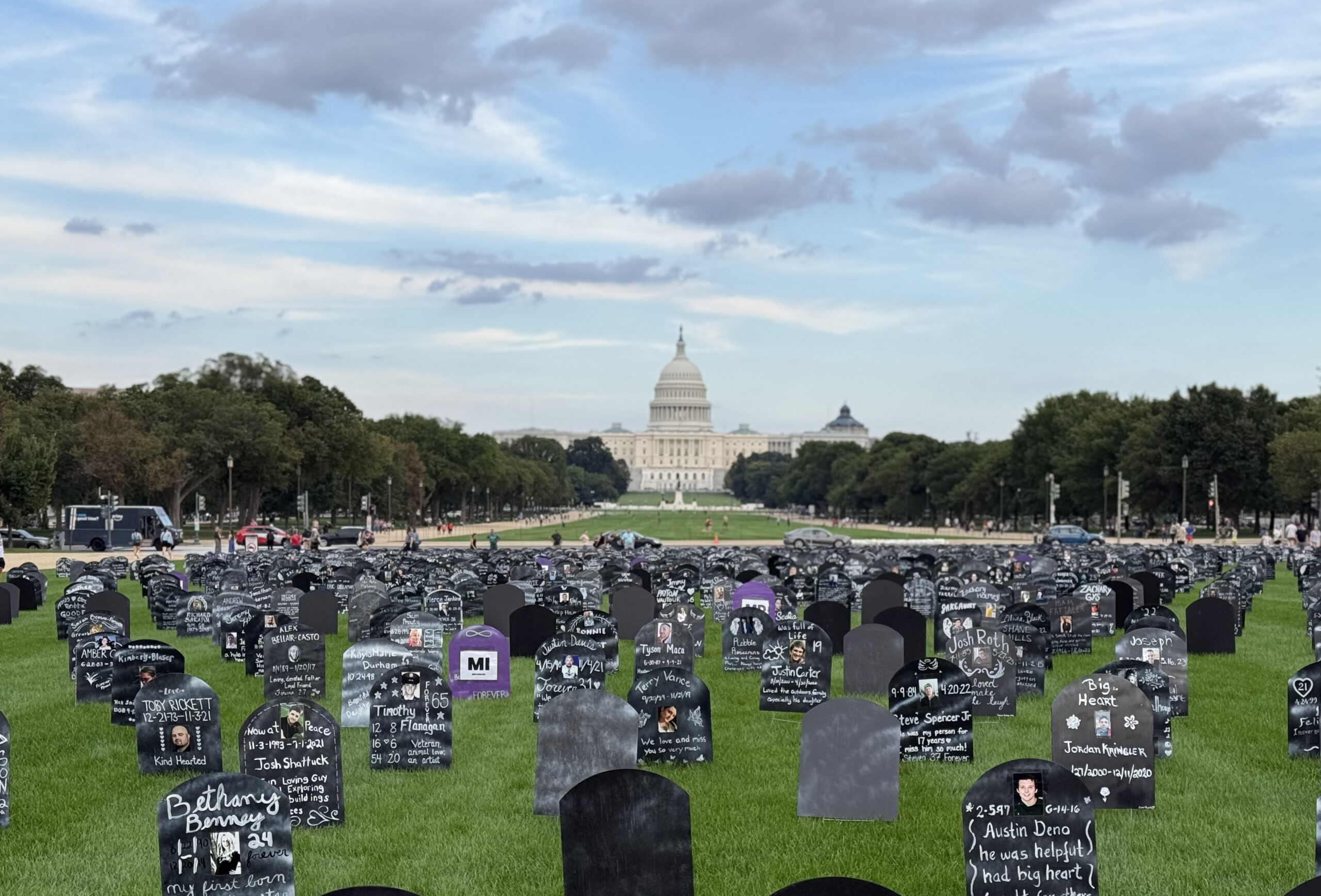
Friday evening was surreal. A breathtaking sunset painted the sky while thousands of tombstones stretched across the National Mall. Turn one way and the Capitol stood in the background; turn the other and the Washington Monument pierced the sky. Each tombstone represented a life lost to overdose, fentanyl poisoning, or substance use disorder. I found Emily’s, lovingly created by her childhood friend Ellen. Around me were so many young faces—lives stolen by greed, by cartels and dealers, and by the brain disease of addiction. A smaller display of crosses held photos, each one lit by a tiny solar light.


The moms gathered in a circle—it’s always the moms. Alexis Pleus, the woman behind Trail of Truth, hugged me tight. No one understands a grieving mother like another grieving mother. Alexis wore a red dress adorned with petals from her late son Jeff’s journal. One entry read:
“I wanna say I’m sorry because I truly am. I love you and thank you for being there for me threw (sp) this, even with all I’ve done.
Love, Jeffrey”
I thought of how many parents have heard apologies like this—children thanking them for putting up with the chaos of addiction. God knows I lived that hell. It reminded me of Emily’s last Mother’s Day card in 2018:
“Mom, thank you for always having my back + for how much you truly care about me. I love you so much and really appreciate how much love you give to me every year”
These are the small consolation prizes after death—proof they knew our love, even if we couldn’t save them.

As the sun set, candles flickered and names were spoken. Community comforted us, but grief hung heavy. Would all this effort—the tombstones, the tears, the hours of work—make any difference? In a world overflowing with noise, does anyone care anymore, other than us mothers who refuse to stay silent?
The next day was the official event. Of course, it rained. The only rain in the forecast for two weeks. Maybe those drops were Heaven’s tears for all this pain.
Still, the event went on. Michael and I set up podcast gear and signs. One poster invited people to share their stories; another showed Emily’s face with the words: “Fentanyl Killed My Child.” People paused—Alzheimer’s walkers, tourists, joggers. And no one could ignore the 4,000 tombstones lined up across the Mall. They screamed from the grave.

With 215 people dying every day, 4,000 tombstones represent less than three weeks of U.S. overdose deaths.
I spoke with families as they arrived: Dawn from Missouri, who found her son dead on the couch. Crystal from Maryland, who lost her brother, Gary, to cocaine laced with fentanyl. Tonya from Louisiana, whose son Trey died at 21—a story uncannily like mine. Again and again, I hear the same threads: sensitive, artistic children, full of compassion, yet caught in the disease that robbed us of who they were. Tonya and I vowed to stay connected, bonded by shared devastation.


When the speakers took the stage, the rain picked up. I threw on a baseball cap—my hair a lost cause—and stepped up. The crowd was small, but the space was sacred. Standing on the National Mall, where Martin Luther King Jr. had once called for justice, I raised my voice against stigma.
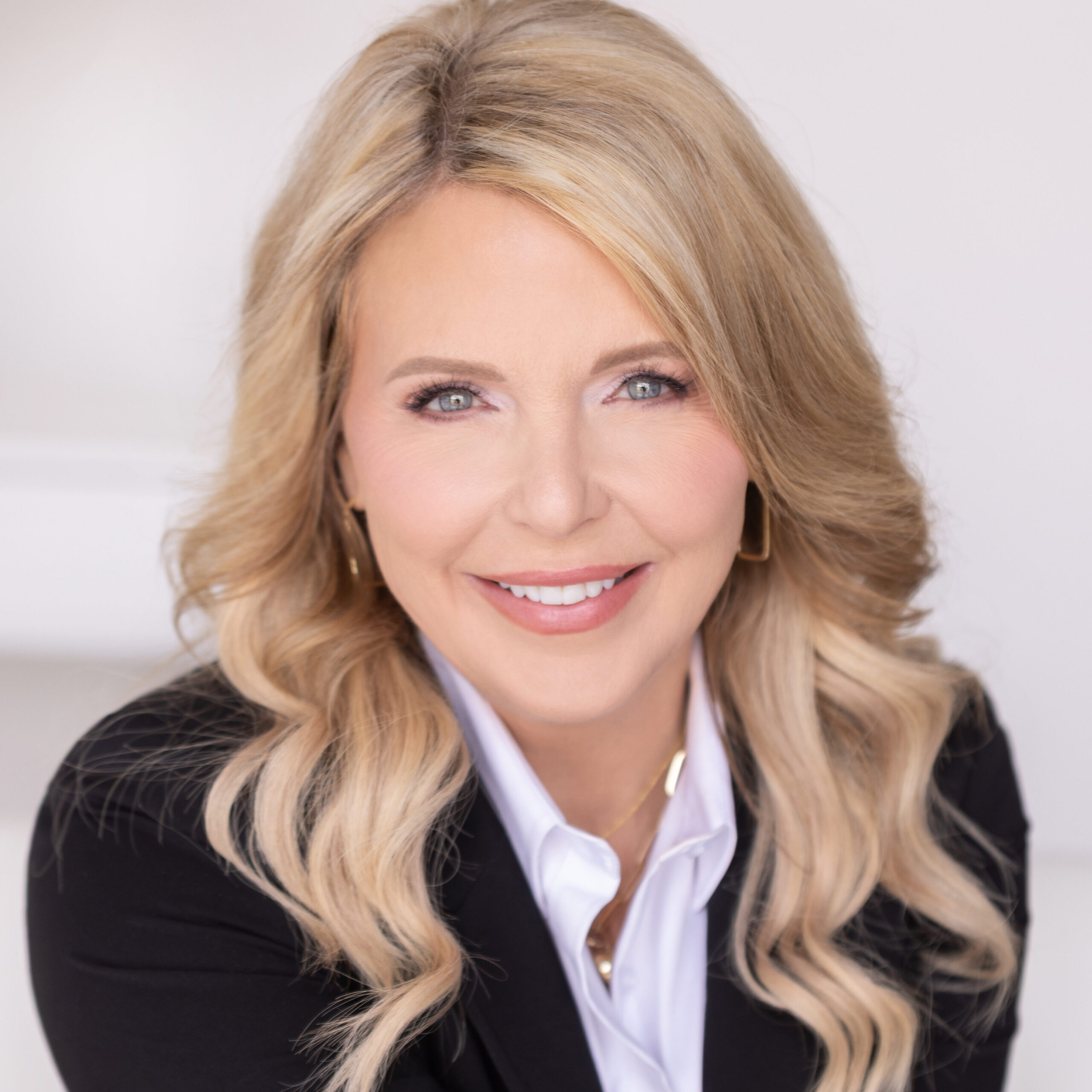
My name is Angela Kennecke. I’m a mother, a journalist, the founder of Emily’s Hope, and—like so many of you here today—someone whose life has been forever changed by this epidemic.
In May of 2018, I lost my 21-year-old daughter, Emily, to fentanyl poisoning. She thought she was taking heroin, but it also contained fentanyl. Three days before we had planned an intervention, Emily was gone.
Emily was brilliant and creative. She was an artist, and she poured her heart onto every canvas she touched. She had friends who adored her, a family who loved her, and dreams that were never realized. She was funny, caring, and passionate. And like so many young people, she was also struggling.
I stand here today not just to remember Emily, but to recognize that every tombstone displayed on the National Mall represents someone’s Emily. Every single one is a child, a sibling, a parent, a friend—loved and cherished. And yet, too often, their stories are overshadowed by stigma.
I believe stigma continues to kill people. It silences families. It pushes people to hide in the shadows. It keeps those who are struggling from reaching out for help because they’re afraid of being judged, afraid of being labeled, afraid of being seen as less than. And stigma also keeps our society from fully addressing this crisis—because it is easier to look away when we convince ourselves that addiction is a choice, or a moral failing, rather than what it truly is: a disease of the brain.
Substance use disorder is a chronic illness, just like cancer or diabetes. It changes the brain. It requires medical care, compassion, and long-term support. And yet we continue to treat it as though it’s a character flaw. This mindset is costing lives. We must replace judgment with compassion and punishment with treatment!
That’s why I founded Emily’s Hope—to turn my grief into purpose. Since 2019, we’ve worked to save lives and change the conversation. We’ve developed a K–12 substance use prevention curriculum that is now being taught in schools across multiple states. We’ve distributed thousands of free doses of naloxone to communities, because no one should die when a reversal medication exists. And we’ve removed financial barriers for treatment, awarding more than half a million dollars in scholarships so people can get the help they need to enter recovery.
But let me be clear—none of this is enough on its own. We need systemic change. And right now, when overdose deaths remain at staggering levels, there are conversations happening about cutting funding for prevention, treatment, and recovery.
Now is not the time to pull back. Now is the time to lean in.
We need to increase funding—not just to keep programs alive, but to expand them. We need prevention in every classroom, recovery supports in every community, and treatment that is available immediately when someone reaches out for help. We need naloxone in every public space, just like fire extinguishers or AEDs. And we need to continue to push back against the stigma that is still silencing families and preventing people from getting care.
These tombstones—nearly 4,000 of them—stretch across this sacred space as a call to action. But they are also something more: they are love made visible. They remind us that every single life mattered. Every single name deserves to be spoken. Every single family deserves to be seen.
So today, let’s commit to honoring them not just with our grief, but with our actions. Let’s make sure that no more parents have to bury their children because of stigma, neglect, or lack of access to care.
This is Emily’s hope. It is my hope. And it is the hope of every family represented here—that through our voices, our advocacy, and our love, we can end this epidemic.
Thank you.
Afterward, I saw familiar faces. Ed Bisch, whose son Eddie was one of OxyContin’s earliest victims, spoke powerfully about Purdue Pharma and the Sacklers. “Fentanyl,” he said, “is OxyContin’s grandchild.” His perseverance humbles me. Other moms I’ve met on this journey—Ann, Natalie, Heather—were there too. It’s this circle of grieving parents that sustains me.


Still, reality hit hard. Despite the display, despite the passion, despite our voices—most lawmakers had already left town. Media coverage was thin. And I wondered, as I often do: will any of this matter?
As Alexis reminded us, every administration—Republican or Democrat—has failed to end this epidemic. Every death represents failed policy. And now, with overdose deaths showing a slight decline, I fear complacency will take root. That stigma will continue silencing our children’s voices, which we mothers carry forward. That cuts to prevention, treatment, and recovery will once again send the message that millions of Americans don’t matter.
But as long as we live, we will not stop speaking. For Emily. For Jeff. For Eddie. For Trey. For every single name on those tombstones.
Faith, Hope & Courage,
Angela


Leave a Reply